The short answer:
BS EN ISO 14122-4:2016 is the standard governing fixed ladders that provide permanent access to machinery and industrial plant. If your ladder’s overall fall height is 3m or above, you’ll need to fit a fall protection device – either a safety cage or a guided-type fall arrester. A ladder cage stops your personnel from falling sideways or backwards, but it won’t arrest a fall. Fall arrest systems, therefore, could be the better specification if your ladder is taller or frequently used. You’ll also need to include a rest platform if someone needs to climb up to 6m in one flight.
Do you know if your fixed ladder needs a cage? If the answer is no, then this guide is for you.
Some fabricators fit a cage to every ladder over a certain height, whereas others skip cages altogether and default to personal fall arrest equipment. If you get the specification wrong, then your ladder may not meet the fixed ladder compliance standard. And not to mention, you could be putting your personnel’s safety at risk.
In this guide, we’ll walk you through what BS EN ISO 14122 actually covers and exactly when your ladder needs a cage or fall arrest system, so you can specify the right ladder for your environment.
What does EN ISO 14122 cover?
BS EN ISO 14122 is titled “safety of machinery – permanent means of access to machinery”. It consists of four parts that cover the following:
- Part 1 = general requirements
- Part 2 = platforms and walkways
- Part 3 = stairways, stepladders, and guardrails
- Part 4 = fixed ladders
BS EN ISO 14122-4:2016 is the standard you’ll need to reference if your ladder provides permanent access to plant, equipment, or a process area. It sets out practical details including:
- The rung and stile dimensions
- The ladder pitch
- Clearances behind and in front of the rungs
- When a cage or fall arrester is required
- How the ladder connects to platforms and landings at the top and bottom
If your ladder is providing general access to a building rather than machinery, then you may need to reference BS 4211:2005+A1:2008 instead. More on that next.
What’s the difference between EN ISO 14122 and BS 4211?
BS EN ISO 14122-4:2016 and BS 4211:2005+A1:2008 cover a lot of the same ground, but they’re designed for very different environments. If you cite the wrong one, you could end up with a ladder that’s unsafe or non-compliant.
You should use EN ISO 14122-4:2016 if your ladder gives permanent access to machinery or industrial plant. That might be a rooftop HVAC unit, a tank, or an elevated walkway that services machinery, for example.
However, you should use BS 4211:2005+A1:2008 if your ladder provides general access to a building rather than machinery. A roof access ladder that’s used for routine maintenance, or one that leads to a loft space or service void that isn’t tied to a specific piece of equipment, would fall under this standard.
Does my fixed ladder need a cage?
BS EN ISO 14122-4:2016 sets out three height thresholds that determine whether your ladder needs a cage or fall arrester:
- If your ladder is below 3m, then you don’t need to fit a fall protection device. However, your own risk assessment may still call for one depending on the site.
- If your ladder is 3m or more, a fall protection device becomes mandatory. You can specify a safety cage with hoops fitted at intervals of no more than 900mm up the climb, or a guided-type fall arrester paired with a sliding sleeve that’s certified to BS EN 353-1:2014+A1:2017.
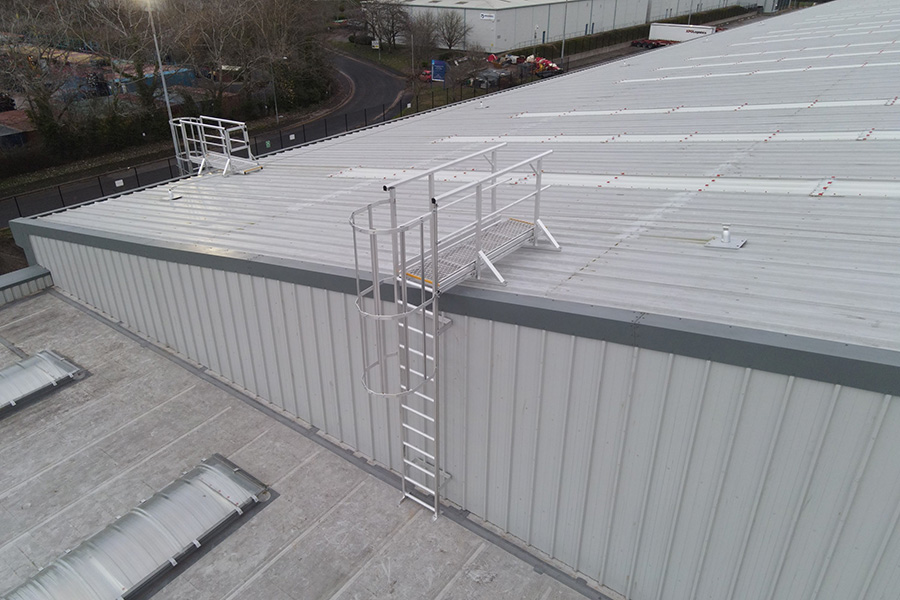
- If your ladder requires someone to climb up to 6m in one flight, you’ll need a rest platform to break up the climb. This is regardless of whether you choose a safety cage or fall arrester.
Should I choose a ladder cage or fall arrester?

If your ladder reaches 3m or above, you can choose between a safety cage or a guided-type fall arrester.
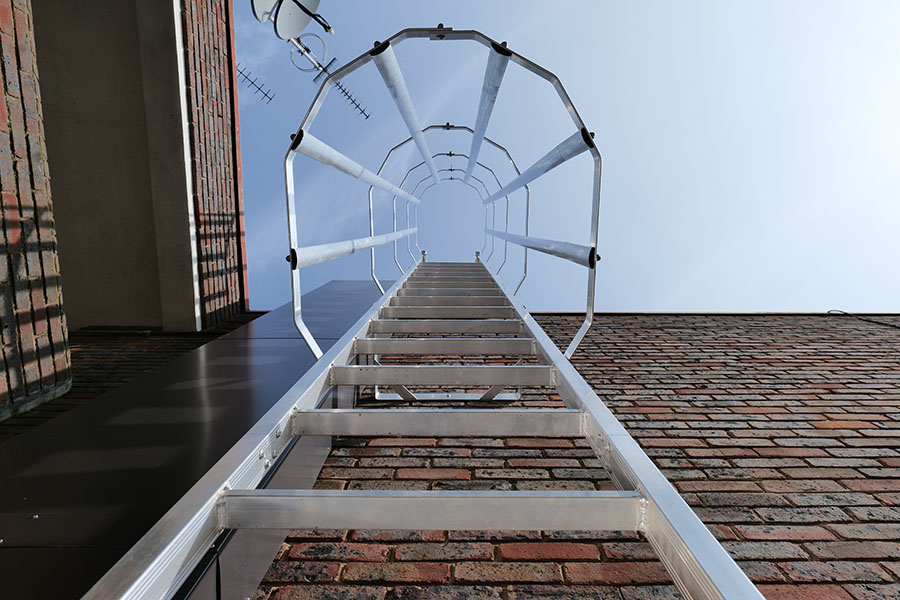
A cage limits how far someone can fall sideways or backwards, but it doesn’t arrest a fall. It can also make a rescue harder if your worker gets stuck or injured partway up, as the rescuer still has to climb inside it to reach them. On the other hand, a guided fall arrester kicks in the moment someone falls, which makes it the better choice if you have a taller ladder or if your ladder is used frequently.
As a general rule of thumb, cages tend to suit shorter climbs just over the 3m threshold. The extra cost and complexity of a fall arrest system can be harder to justify at this height. Fall arresters are ideal if the climb is longer, more frequent, or more exposed.
Before you decide, take some time to work out:
- How high the climb is
- How often people will use the ladder
- Who’s likely to be using it
- How would a rescue happen if something went wrong
The answer to these questions will help you determine which ladder specification is right for your environment.
Get your ladder specification right with Katt Safety
At Katt Safety, we supply an extensive range of fixed ladders that are tailored to meet your exact requirements. Our RL40 Series includes cage and fall arrest configurations, as well as optional grab rails, parapet platforms, walkways, and retractable stiles. The entire Katt Climb range is specifically designed to meet the EN 14122 ladder standards, so you can rest assured that your team will remain protected and compliant on site.
Not sure whether your ladder needs a cage or fall arrest system? Fill out our ladder configurator form and we’ll get back to you ASAP with the correct specification.