It’s a common misconception that ladders are banned from building sites. While temporary ladders do raise some safety concerns, fixed access ladders are a fully compliant solution to help your personnel safely reach rooftops, plant areas, and elevated services. The key lies in choosing the right ladder for the job, and making sure that it meets today’s safety standards.
Below, we share everything you need to know about how to select the best ladder for building maintenance on your site.
What are the fixed ladder regulations?
The benchmark for ladder safety standards in the UK is BS 4211:2005. This covers all fixed ladders that need to provide permanent access to equipment or elevated areas.
Key requirements include:
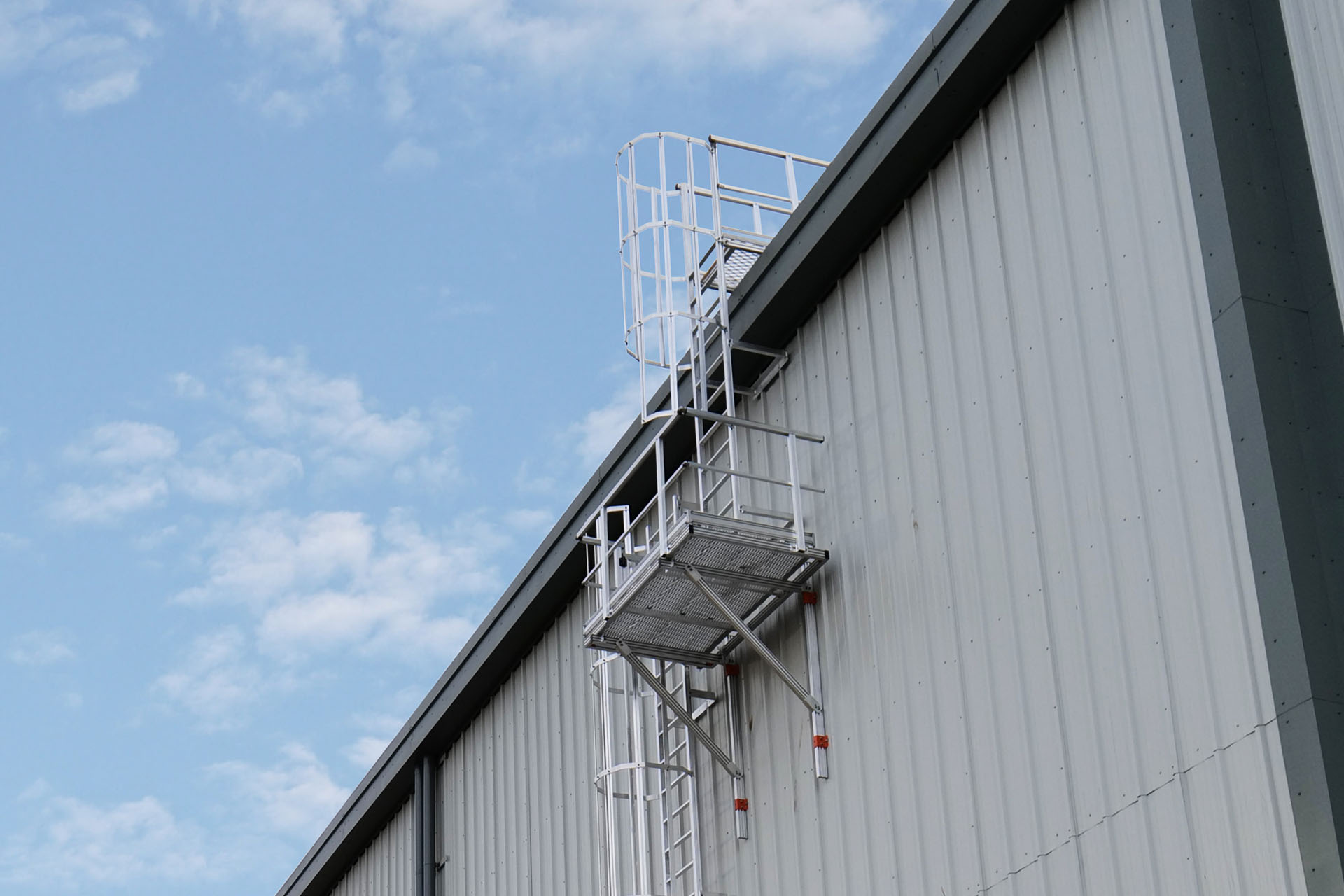
- Ladders exceeding 6 metres in height must be broken up with intermediate platforms or landings
- Ladders may need an integrated safety cage or vertical fall arrest system to help prevent falls from height
- Ladder rungs must be evenly spaced and designed to prevent slips
- The angle of the ladder should be near-vertical but within regulated tolerances
- Guardrails must be installed to protect users from edge-related fall risks when moving from the ladder to a roof or platform
Failure to meet these fixed ladder regulations could result in HSE action – or even worse, a fall-related injury.
Questions to ask yourself when selecting a building access ladder
What is the vertical height of the area that needs to be accessed?
If the height is under 2.5m, a simple step-over or short vertical ladder may suffice. For heights between 2.5m-6m, you’ll need a single straight ladder with handrails or a cage. And for anything over 6m, a modular ladder system with intermediate platforms or rest landings is required under BS 4211.
Is the ladder needed for frequent or occasional use?
If the ladder will be used frequently, we recommend choosing one with wider rungs, fall protection, and integrated handrails. A simpler configuration may be acceptable if it’s only needed for occasional maintenance; provided it’s still fully compliant with the UK ladder safety standards.
Will users be carrying tools or equipment while climbing the ladder?
If yes, you’ll need to choose a ladder with integrated rest platforms to allow the user to safely pause during the climb. A companion hoist system may also be beneficial to reduce the need for workers to transport tools by hand, which can pose various safety risks.
Will the ladder be used to access rooftops?
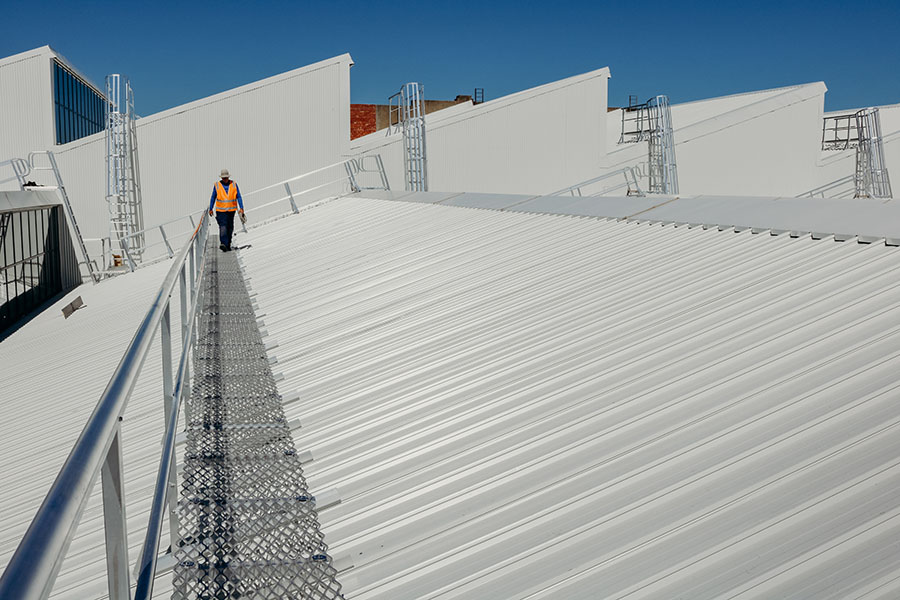
The type of roof will help to determine the appropriate transition needed. For example, a flat roof might require a ladder with a vertical exit and guardrails, whereas a pitched roof may need a platform or walkway.
Is there any existing fall protection in place?
If your ladder is over 2m high, you’ll need some form of fall protection in place. This could include cages, safety lines, or integrated fall arrest systems.
Will ladders be exposed to harsh conditions?
Ladders made from non-corrosive materials may be required for areas that experience high winds or are located near the coast. You could also consider additional bracing to make the ladder more stable in high wind areas.
Discover our comprehensive range of fixed access ladders
We are proud to supply an extensive range of fixed access ladder solutions to meet your specific site requirements. Every ladder in our range is built from lightweight, weather-resistant, maintenance-free materials, and can be easily installed and adjusted on site with minimal tools required.
Our range of KATT 2 modular ladders include:
- RL20 Series Angled Fixed Access Ladders – for plant rooms, service platforms, and low-level roof access where a vertical climb is not appropriate
- RL30 Series Vertical Fixed Access Ladders – for roof and platform access in tight or restricted spaces
- RL40 Series Caged Access Ladders – for maintenance access in commercial or industrial settings, with integrated safety cages for fall protection
- RL50 Series Vertical Line Access Ladders – an alternative to caged ladders for taller climbs, with an integrated vertical fall arrest line
- RL70 Series Modular Step Access Ladders – for low-level access or where roof transitions are involved, can be combined with handrails and guardrails
All our ladders are fully compliant with BS 4211:2005 and BS EN ISO 14122-4:2016. They are designed to seamlessly integrate with our industry-leading range of walkways, guardrails, and fall protection systems – resulting in a complete access solution that keeps your workforce safe and your project on track.
Safety starts with the right ladder
Choosing the right ladder for your building can feel like a minefield. But it doesn’t have to be. We’re here to guide you through the selection process and help you choose a ladder that is specifically tailored to your site safety needs.
We’ll take the time to understand your building layout, roof type, access frequency, and fall protection needs. Once we have this information, we’ll work with you to choose the best-fit ladder from our range – whether it be an angled ladder for plant access, or a multi-section caged system with rest platforms. We can also advise on roof transitions, intermediate platforms, and integration with our walkways, guardrails, and fall arrest systems.
Fill in our ladder configurator form to request your free, no obligation quote today.